
Carbon monoxide is colourless, odourless and tasteless — the reason it is so often called the silent killer, and the reason the numbers around it deserve more attention than they usually get. This page brings together the latest UK carbon monoxide poisoning statistics in one place: deaths, fire and rescue service incidents, hospital cases, alarm ownership and the legal rules on CO alarms. The figures come from official sources — the Office for National Statistics (ONS), the Ministry of Housing, Communities and Local Government (MHCLG), the English Housing Survey and the Gas Safe Register — and every number is linked to its source at the end of the page.
Key facts and figures
- 60 accidental deaths with carbon monoxide as the secondary cause were registered in England and Wales in 2024.
- 35 of those deaths had accidental exposure to smoke, fire and flames as the underlying cause; the total is not limited to faulty-appliance poisoning.
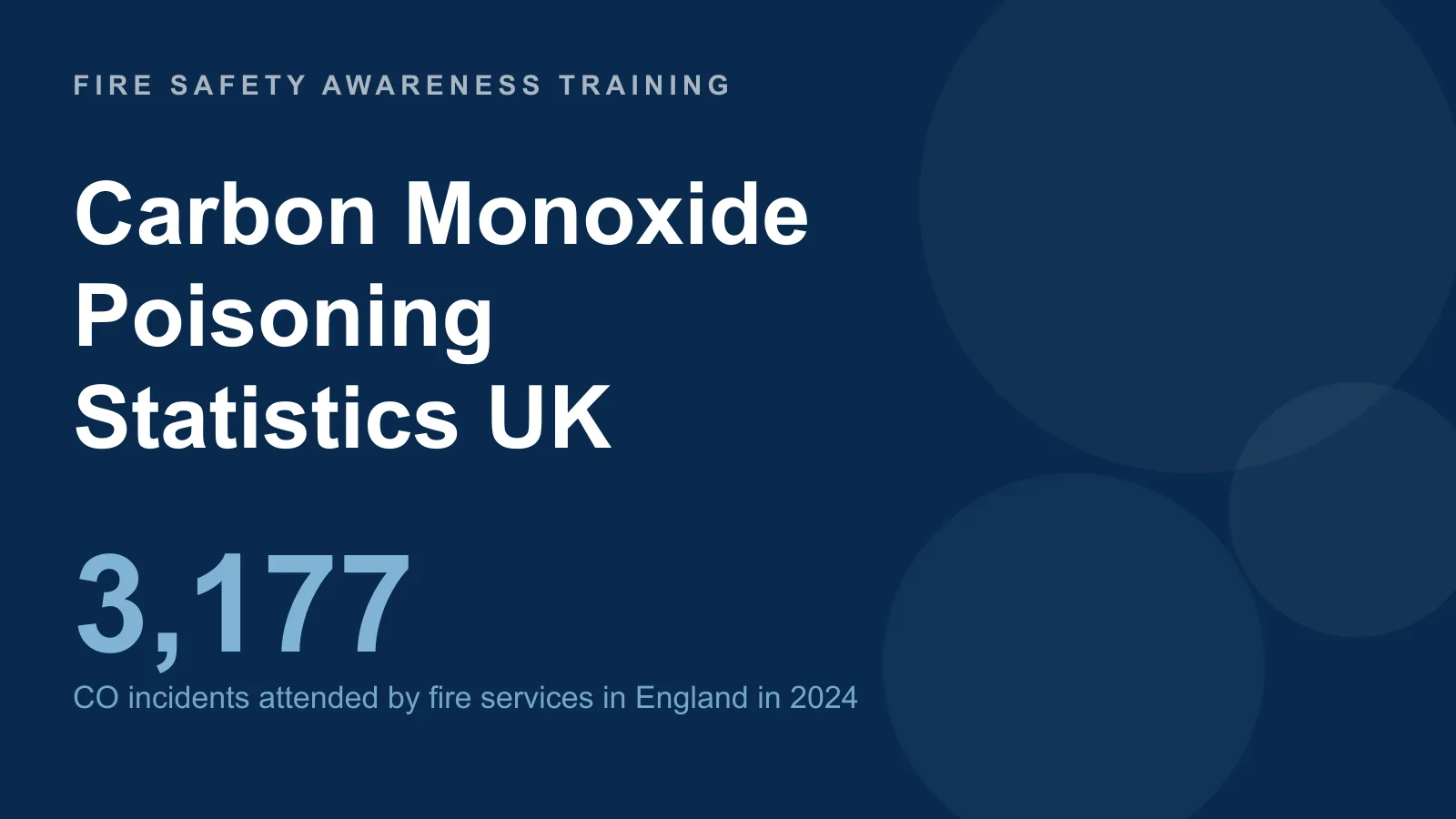
- 3,177 CO-related incidents were attended by England’s fire services in 2024, including 2,045 good-intent fire false alarms.
- ~4,000 annual A&E attendances were estimated in a Department of Health release in 2011; this is a historical estimate.
- 62% of dwellings in England had a CO alarm in 2024, compared with 60% in 2023.
- 7,116 At Risk or Immediately Dangerous defects on gas work were reported in Gas Safe Register’s 2023/24 inspection report.
- £5,000 is the maximum penalty under England’s alarm regulations for failure to comply with a remedial notice.
- 116 deaths assigned toxic effects of CO as the secondary cause were registered in England and Wales in 2020, across accidental and other underlying causes.
Checked on 15 October 2026. Each measure has its own period, geography and definition. The CO death and incident extracts are ad-hoc releases, not guaranteed annual publications.
How many people die from carbon monoxide poisoning in the UK?
ONS recorded 60 accidental deaths with toxic effects of carbon monoxide as the secondary cause in England and Wales in 2024. Of these, 35 had accidental exposure to smoke, fire and flames as the underlying cause, while 24 had accidental poisoning by other gases and vapours. The overall figure must not be described as 60 deaths from non-fire appliance leaks.
These are deaths registered in 2024, which may have occurred earlier because inquests can delay registration. The publication is a commissioned ad-hoc analysis and does not give a monthly breakdown, so it cannot establish that deaths peaked in December.
A separate historical ONS table reports 116 deaths with toxic effects of CO as the secondary cause in 2020, compared with 177 in 2010. That broader measure includes different underlying causes and is not directly comparable with the accidental-only 2024 extract.
Death certificates, attended incidents and hospital records measure different aspects of harm. Their totals cannot be added together to produce a single number of people poisoned.
How many carbon monoxide incidents do fire services attend?
England’s fire services attended 3,177 CO-related incidents in 2024, compared with 786 in 2012. The MHCLG extract contains 23,142 records across 2012–2024. The latest year included 2,045 good-intent fire false alarms, 18 fires and 1,114 other incidents; it is not a count of confirmed poisoning cases.
Recorded callouts may be influenced by alarms, awareness and reporting, but this dataset does not quantify their contribution to the increase. A rise in attendance cannot alone establish either a rise in harmful exposure or a reduction in deaths caused by better detection.
How many people go to hospital with carbon monoxide poisoning?
The Department of Health’s November 2011 release estimated about 4,000 A&E attendances and 200 hospitalisations a year. Those historical estimates describe the evidence available at the time; they are not measured 2025 or 2026 totals.
Symptoms can include headache, dizziness, nausea, tiredness and confusion, and may resemble other illnesses. NHS advice is to go outside and seek medical advice if poisoning is suspected, and not return until advised it is safe.
Call NHS 111 for suspected symptoms. Call 999 for severe signs such as difficulty breathing, sudden confusion, loss of consciousness or chest or muscle pain after possible exposure. An alarm is a warning device, not a medical diagnosis or a substitute for appliance maintenance.
The table keeps the distinct statistical measures and dates together.
| Measure | Latest figure | Period & trend |
|---|---|---|
| Accidental CO-related registered deaths, England and Wales | 60 | 2024; includes fire-related underlying causes |
| Deaths with CO as secondary cause, England and Wales | 116 | 2020 historical all-underlying-cause measure |
| CO-related fire-service incidents, England | 3,177 | 2024; includes 2,045 good-intent fire false alarms |
| Estimated A&E attendances | ~4,000 a year | Historical Department of Health estimate, 2011 |
| Estimated hospitalisations | ~200 a year | Historical Department of Health estimate, 2011 |
| Dwellings with a CO alarm, England | 62% | 2024; 60% in 2023 |
| At Risk / Immediately Dangerous gas-work defects | 7,116 | Gas Safe Register inspections, 2023/24 |
| Maximum penalty under England’s alarm regulations | £5,000 | Failure to comply with a remedial notice |
How many UK homes have a carbon monoxide alarm?
The latest English Housing Survey housing-quality report estimates that 62% of dwellings had a carbon monoxide alarm in 2024, up from 60% in 2023. That leaves 38% without a recorded alarm; it does not imply that every dwelling has the same combustion exposure.
Separately, 93% of households self-reported at least one working smoke alarm in 2024/25. Our smoke alarm statistics explain that measure. A conventional smoke alarm does not detect CO unless it is a combined device designed to do so.
CO alarms complement safe installation, maintenance and ventilation. Fit an appropriate alarm where recommended, follow its installation and testing instructions, and replace it at the end of its stated life.
What causes carbon monoxide poisoning in UK homes?
Gas Safe Register’s 2023/24 report recorded 7,116 defects on gas work classed as At Risk or Immediately Dangerous. This is a count of defects found through its activities, not a representative estimate of unsafe UK homes or a count of CO incidents.
CO can form when carbon-containing fuels burn incompletely. Potential sources include:
- Faulty or poorly maintained gas boilers, fires, water heaters and cookers
- Blocked, leaking or unswept flues and chimneys
- Solid-fuel stoves and open fires without adequate ventilation
- Portable generators, engines or fuel-burning tools run in garages or enclosed spaces
- Barbecues brought inside tents, awnings, caravans or homes to cook or for warmth
Have appliances and flues maintained by appropriately qualified people, keep ventilation clear and use suitable CO alarms. Never use barbecues, generators or camping stoves indoors. If an alarm sounds or poisoning is suspected, go outside and seek help; do not rely on your senses to detect the gas.
What are the rules on carbon monoxide alarms for landlords?
England’s rules cover specified private and social tenancies, with exemptions. Relevant landlords must provide a CO alarm in each room used as living accommodation containing a fixed combustion appliance, except a gas cooker. Required alarms must work at the start of a new tenancy and faulty alarms must be repaired or replaced as soon as reasonably practicable.
Local authorities can issue remedial notices and impose penalties of up to £5,000 for failure to comply. A smoke alarm is also required on each storey used as living accommodation. The official guidance explains the tenancy exemptions and how these duties are enforced.
The same combustion risks exist beyond housing. Workplaces with gas boilers, LPG heaters, commercial kitchens or fuel-burning plant carry CO risk too, and staff who understand alarms, fire classes and evacuation respond faster when one sounds — exactly the ground covered by our online fire safety awareness training course for every UK employee.
Frequently asked questions
How many people die from carbon monoxide poisoning in the UK each year?
ONS’s 2024 ad-hoc extract records 60 accidental deaths with CO as the secondary cause in England and Wales, including 35 with accidental exposure to smoke, fire and flames as the underlying cause. It is not a UK-wide count limited to domestic gas leaks.
How many carbon monoxide poisoning cases are there per year in the UK?
There is no single interchangeable total here. England’s fire services attended 3,177 CO-related incidents in 2024, including false alarms. The often-quoted 4,000 annual A&E attendances are a historical estimate published in 2011.
How many UK homes have a carbon monoxide alarm?
The English Housing Survey estimates that 62% of dwellings in England had a CO alarm in 2024, compared with 60% in 2023. These are England figures, not a combined UK estimate.
Do landlords have to provide carbon monoxide alarms?
Relevant landlords in England must provide CO alarms in living accommodation with a fixed combustion appliance, excluding gas cookers, and meet testing and repair duties. Specified tenancies and exemptions apply; other UK nations have their own rules.
When are carbon monoxide deaths most common?
Fuel-burning appliances can create risks throughout the year, with heating adding exposure in colder months. The cited 2024 ONS extract has no monthly breakdown and cannot establish a December peak.
Are carbon monoxide incidents rising or falling?
Recorded CO-related fire-service incidents rose from 786 in 2012 to 3,177 in 2024. This includes false alarms and is not a trend in confirmed poisoning. It cannot establish the effect of alarms on deaths.
Related guides
- Smoke Alarm Statistics UK: Ownership, Failures & Lives Saved
- Candle Fire Statistics UK: Fires, Deaths & Seasonal Trends
- UK Fire Classes Explained: A, B, C, D, F (and L)
- Who Is Responsible for Fire Extinguishers in the UK?
- Types of Fire Extinguisher: The Complete UK Guide
Sources & references
- ONS — 2024 accidental CO death registrations and coding notes
- ONS — historical secondary-cause T58 deaths, 2010–2020
- MHCLG — CO-related incidents, 2012–2024, including false alarms
- English Housing Survey 2024/25 — housing quality, CO alarms in 2024
- Department of Health — historical hospital estimates, 21 November 2011
- NHS — symptoms, prevention and action for suspected poisoning
- Gas Safe Register — At a Glance 2023/24, gas-work defects
- MHCLG — England alarm regulations: scope, exemptions and duties
Make sure your team knows what the alarms mean and how to respond — get every employee fire aware in around 90 minutes.
Explore the Fire Safety Awareness Training course →
Mark writes about workplace health & safety, fire safety awareness and accredited online training for Fire Safety Awareness Training, part of Online CPD Academy.