
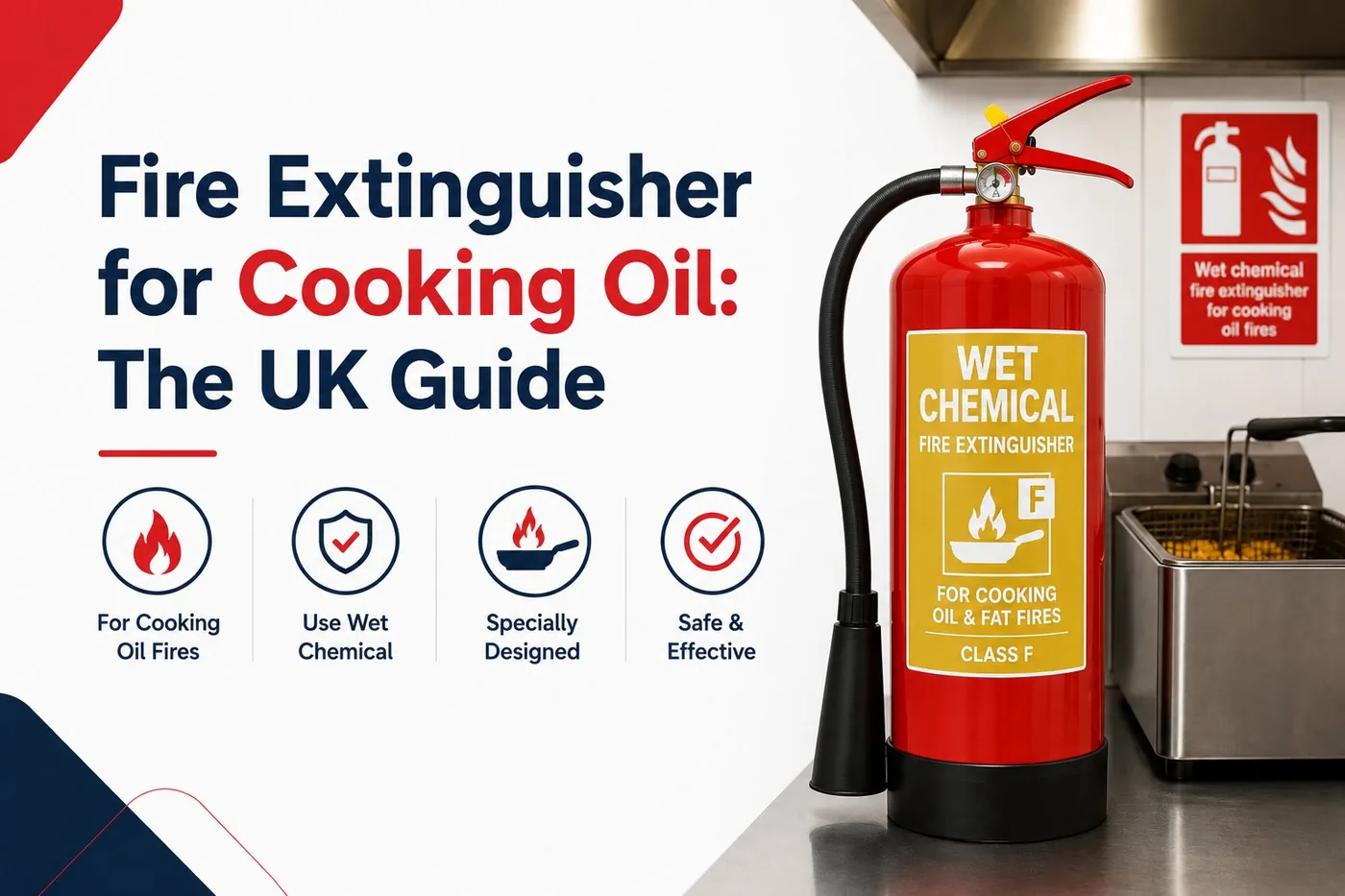
A cooking oil fire — the chip pan, the deep fat fryer, the forgotten pan of vegetable oil — is one of the most dangerous fire scenarios in any UK premises. Cooking is also the leading cause of accidental dwelling fires in England, with cooking appliances the ignition source in 9,928 of England’s 23,795 accidental dwelling fires (41.7%) in the year ending March 2026. A quick, safe response matters, and the wrong response — particularly water — can turn a manageable incident into a life-threatening one.
This page sets out what to do if a cooking oil fire starts, what to never do, when a fire blanket is enough, and when you need a wet chemical extinguisher. It is written first for the moment of decision, not as a technical reference.
What to do if a cooking oil fire starts
If a cooking pan catches fire at home:
- Raise the alarm and alert other people nearby.
- Switch off the heat only if you can do so safely without reaching across flames or smoke.
- Do not move the pan, throw water on it or attempt to carry it outside.
- Leave the kitchen and close the door behind you if safe.
- Get out, stay out and call 999 from a safe place.
In a workplace, follow the emergency plan. Only trained people should consider suitable firefighting equipment where it is safe; do not delay raising the alarm or evacuation.
What never to do
Three actions that turn a kitchen fire into a kitchen disaster.
Never use water. Water on burning cooking oil is the single most dangerous mistake in domestic fire safety. Water is denser than oil, so it sinks to the bottom of the pan. There it instantly turns to steam — and one volume of water becomes about 1,700 volumes of steam in the time it takes to vaporise. The steam expands violently upwards, ejecting burning oil out of the pan as a fireball that can reach the ceiling. Whatever was on fire is now everywhere, including potentially on the person who threw the water.
This is not a theoretical hazard. UK fire and rescue services run public information campaigns specifically to discourage water on chip-pan fires because the result is so reliably catastrophic. A bucket of water on a chip pan is the canonical bad decision.
Never move the pan
A burning pan picked up to be carried to the sink or out the back door spreads burning oil across every surface in between. Spilled burning oil can cause severe injury. If the destination was outside, the door has now been opened to feed the fire fresh air on the way through. If it was the sink, the next instinct is to turn on the tap — see above.
Never use the wrong extinguisher
Foam, dry powder, and CO2 all do something unhelpful on a Class F cooking-oil fire. Foam splashes the burning oil. Dry powder cannot interact with the oil chemistry the way it does with petrol or gas, and the discharge force can splash burning oil. CO2 has the same splash problem and disperses too quickly to address the oil itself. None of these are kitchen options. The wet chemical extinguisher is the only common UK extinguisher whose chemistry actually addresses cooking oil — through saponification, the soap-forming reaction between the potassium-acetate agent and the burning fat.
Why water is so catastrophic on burning oil
Worth understanding briefly, because it is the basis for all of the above.
A pan of burning cooking oil sits at around 350°C — well above the boiling point of water (100°C) and well above water’s flash-vaporisation threshold. Pour water onto the surface and a few things happen instantly.
The water sinks beneath the burning oil because oil is less dense than water. So the water now sits at the bottom of the pan, with hot oil above it.
The water at the bottom of the pan starts boiling violently. Each drop of water expands roughly 1,700 times as it converts to steam. The expansion is faster than the oil above it can move out of the way.
Rapid steam expansion can eject burning oil and spread flames to people, cabinets and surrounding surfaces. The outcome depends on the quantities and conditions; never try this or infer a safe distance from a demonstration.
Fire-service demonstrations show how water can violently eject burning oil. Flame height depends on the test conditions; no fixed height or safe standing distance should be inferred from a demonstration.
Fire blankets — limited, trained use
A blanket may be part of a workplace’s planned response to a small contained fire. It is not a universal first response for householders: local fire-service advice is to leave a burning pan, close the door and call 999.
To use it:
- Switch off the heat if you can do so safely.
- Pull the blanket down by its tabs.
- Hold the blanket so it forms a curtain shielding your hands and arms from the rising heat.
- Drape it over the pan from the front edge to the back, ensuring the entire opening of the pan is covered.
- If a blanket has been safely applied, leave it undisturbed and withdraw. A fixed wait of 30 minutes does not establish that the oil is cool or re-entry safe.
A fire blanket works by smothering. With air sealed off, the fire suffocates within seconds. The blanket also contains the heat, preventing the fire from finding more fuel above the pan.
The limits of the fire blanket:
- It only works if it can fully cover the pan or fryer. A small blanket on a large commercial fryer cannot create the necessary seal.
- It only works for fires still contained in the cooking vessel. Once flames have escaped to walls, cabinets, or extraction hoods, the blanket cannot reach them.
- It is a single-use item once contaminated. After a fire, the blanket goes in the bin and is replaced.
Choose a blanket that meets the relevant standard and suits its assessed use. Do not reach over flames or escalate to another appliance after an unsuccessful attempt. A spreading fire, smoke or uncertainty means leave.
Wet chemical — for assessed workplace cooking risks
A suitably rated wet chemical extinguisher can control specified cooking-oil fires through cooling and a sealing layer. Its use requires training and safe conditions; it is not an instruction to fight a larger fire when a blanket is inadequate.
The standard pattern:
- Follow the particular unit’s marked operating distance and hold its lance as instructed in training.
- Apply the agent using the manufacturer’s method for the oil surface; do not substitute a generic sweeping technique.
- Follow the specified discharge method and withdraw if the fire is not promptly controlled or escape is threatened.
- Leave the agent layer undisturbed, withdraw and await competent clearance. A fixed time does not establish that the oil or surrounding area is safe.
Have a competent assessment specify equipment for the actual fryer, oil volume and layout. Agent capacity and F rating are different measures. For example, the Firehawk FBWC6 is a 6-litre unit with a 13A/75F rating; 13A is not a “13F” cooking-oil rating. See our wet chemical guide.
Domestic vs commercial — different equipment
The right kitchen fire safety setup is different at home and at work.
At home, use appropriate working smoke and heat alarms, follow their testing and replacement instructions, and never leave cooking unattended. Alarm requirements vary by UK nation and tenure. In a pan fire, switch off the heat only if safe, leave and call 999.
A thermostatically controlled fryer can reduce the risks associated with a traditional chip pan. Owning one does not make a generic extinguisher size appropriate; seek fire-service advice and prioritise safe escape.
For a commercial kitchen, a competent risk assessment should specify equipment for the appliances, oil quantities, electrical risks and escape arrangements. This may include suitable Class F equipment, fire blankets and fixed suppression, alongside other necessary cover. There is no universal rule that one particular size or a blanket beside every appliance is sufficient.
For commercial settings, training matters as much as equipment. The kitchen team needs to know what to do in the first 30 seconds — and that knowledge has to be refreshed regularly. Our online fire safety awareness training course covers the basics every employee needs.
When to evacuate and call 999
The single most important rule: if you have any doubt, leave.
Specific triggers to evacuate:
- The fire has spread beyond the pan or fryer to walls, cabinets, or the extraction hood.
- Smoke is filling the kitchen and breathing is becoming difficult.
- Your fire blanket cannot fully cover the burning vessel, or you do not have one.
- You do not have a wet chemical extinguisher within easy reach.
- You used water and the fire is now much larger.
- You feel uncertain. Uncertainty under pressure is itself a signal.
To evacuate safely:
- Get out of the kitchen and close the door behind you. The closed door starves the fire of oxygen and slows the spread by minutes — vital minutes.
- Continue out of the building, telling anyone you pass to leave. Do not stop to collect possessions.
- Call 999 from a safe distance. Be specific about the address and the kitchen location within the building.
- Do not go back in for any reason. Do not re-enter until the fire and rescue service confirms it is safe.
England recorded 184 dwelling-fire deaths in the year ending March 2026. The ignition-source table records 18 deaths in accidental dwelling fires involving cooking appliances; it does not support a claim that most dwelling deaths arose from kitchen firefighting attempts or re-entry.
Frequently asked questions
What extinguisher do I need in my kitchen?
At home, prioritise suitable alarms, safe cooking and escape. Commercial kitchens need equipment selected through a competent risk assessment, including an appropriate Class F rating where required.
Can I use a fire blanket on a chip pan fire?
Only where it is a small contained fire, you are trained and conditions are safe. Do not reach through flames or delay escape. For a pan fire at home, follow fire-service advice to leave and call 999.
Why doesn’t water work on cooking oil fires?
Water can rapidly turn to steam in hot cooking oil and eject burning oil violently. Never put water on a chip-pan or fryer fire.
Do I need a wet chemical extinguisher at home?
There is no universal requirement triggered simply by owning a fryer. Seek local fire-service advice; safe cooking, alarms and escape remain the priorities.
How big should my Class F extinguisher be?
Have the fryer, oil volume, layout and manufacturer’s test rating assessed together. A 13A rating is for solids, not a “13F” cooking-oil rating; one generic number does not certify a whole kitchen.
Where this connects
For the wet chemical extinguisher itself — chemistry, capacities, sizing — see our wet chemical fire extinguisher page. For the wider classification of fires (including Class F context), see our UK fire classes guide. For where these extinguishers fit in the wider type system, the fire extinguisher types hub is the place to start.
If you run a commercial kitchen and need to train your team on the basics of fire safety, the online fire safety awareness training course covers what every UK employee needs in 90 minutes — RoSPA-approved, CPD-accredited, and designed to satisfy the training duty under the Regulatory Reform (Fire Safety) Order 2005.
Related guides
- Wet chemical fire extinguisher: the UK guide
- Fire classes explained: the UK guide
- Types of fire extinguisher: the UK guide
Sources & references
Official guidance and standards checked on 15 October 2026.
- Cambridgeshire Fire and Rescue — household pan fires
- SFRS — cooking safety and escape
- MHCLG — FIRE0602, year ending March 2026
- Fireblitz — tested 13A/75F specification
- BS 5306-8:2023
- Regulatory Reform (Fire Safety) Order 2005
Train your kitchen and workplace team on the fire safety basics every UK employee needs.
Explore the Fire Safety Awareness Training course →
Mark writes about workplace health & safety, fire safety awareness and accredited online training for Fire Safety Awareness Training, part of Online CPD Academy.