
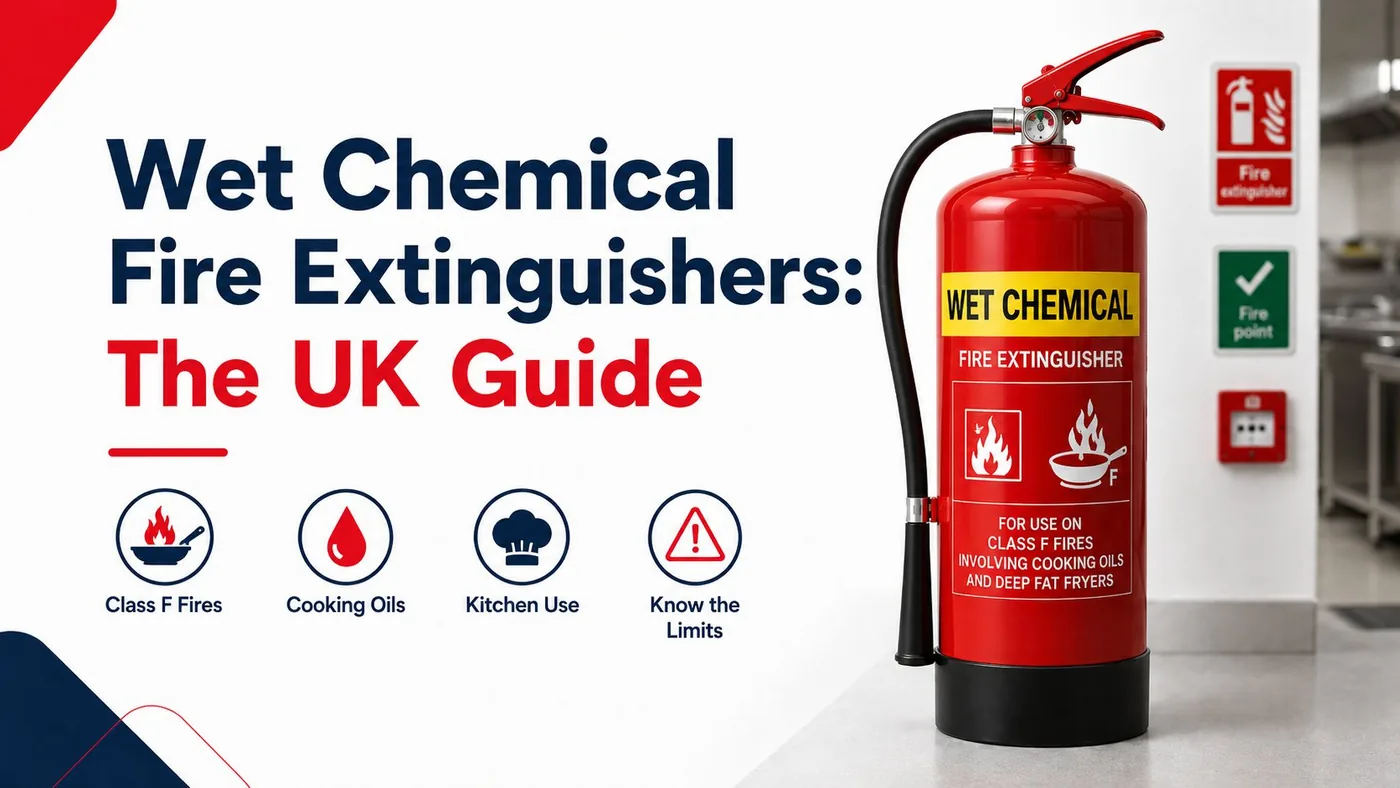
The yellow-labelled wet chemical fire extinguisher is the dedicated answer for Class F fires — cooking oils and fats. It is the standard equipment for commercial kitchens, takeaways, hotel kitchens, school catering, and anywhere a deep fat fryer is in use. It is also the type most often misunderstood: its Class F capability does not automatically establish suitability for petrol, paint or other Class B fuels.
This page covers what wet chemical extinguishers do, the saponification chemistry that gives them their name, how F-rating sizing works for different kitchen scales, and how wet chemical fits alongside the fire blanket as the two-part answer for kitchen fire safety in UK premises.
What a wet chemical fire extinguisher is
A wet chemical extinguisher is a stored-pressure unit containing an aqueous solution of potassium salts — typically potassium acetate, sometimes with potassium citrate or potassium bicarbonate. The body is signal red with a yellow panel near the label. Standard UK capacities are 2 L, 3 L and 6 L.
The most distinctive feature is the discharge mechanism. Wet chemical extinguishers are supplied with a long lance rather than a short nozzle — typically a metal tube around 30 to 40 cm long ending in a fine spray head. The lance is not optional or decorative; it is fundamental to safe operation, and it is why a wet chemical extinguisher is used differently from any other type.
Wet chemical extinguishers are tested under BS EN 3 and selected and positioned under BS 5306-8:2023.
How wet chemical works — saponification
Drop a wet chemical mist onto burning cooking oil and three things happen at once.
The mist cools the oil surface
A 6 L wet chemical unit empties enough water-based agent to drop the oil temperature from its burning state (often 350°C and above) toward something more manageable. Cooling reduces the rate of vapour generation, which reduces the fire.
The fine mist limits splashing
Hit a pan of hot oil with a heavy water jet and the oil ejects upwards in a fireball. A wet chemical mist arrives gently and at lower velocity — the lance is sized to deliver the agent in a soft, fine spray rather than a concentrated stream.
The potassium salts saponify the oil
This is the chemistry that gives wet chemical its name. The alkaline potassium salt reacts with the fatty acids in the burning oil through a process called saponification — the same reaction that turns vegetable oil and lye into soap. The reaction product is an inert, foamy soap layer that sits on the oil surface, sealing it from the air. With the surface sealed and the oil cooled, the agent helps control the fire and reduce re-ignition.
Wet chemical is designed for cooking-oil hazards. Other products may have an F rating only where tested accordingly; ordinary water, foam, powder and CO2 units must not be assumed suitable for hot cooking oil.
What wet chemical extinguishers tackle
Class F is the headline category — fires involving cooking oils and fats. This includes:
- Animal fats — beef dripping, lard, bacon fat
- Vegetable oils — sunflower, rapeseed, olive, palm
- The hot oil in deep fat fryers, chip pans, and cooking ranges
- Burning grease in extraction hoods and ducting (though primary cover for ducting is normally a fixed suppression system)
Some wet chemical extinguishers also have A or B ratings. These identify tested capabilities of the particular unit; a cooking-oil rating alone does not establish suitability for solid materials or conventional flammable liquids.
Limits to wet chemical use:
- Class B capability is product-specific. Some wet chemical units also carry a B rating, while others do not. Follow the actual rating and the manufacturer’s fuel-compatibility instructions.
- Class C (flammable gases). No relevant mechanism.
- Class D (combustible metals). The agent reacts unhelpfully with hot reactive metals.
- Live electrical equipment. Most wet chemical extinguishers are not dielectrically rated. A unit that does carry a current dielectric rating can be used on live equipment within stated limits, but standard wet chemical is conductive and not safe on energised equipment.
F-rating — sizing for the right kitchen
Wet chemical extinguisher capacity is matched to the kitchen by F-rating. The number expresses the volume of cooking oil the extinguisher has been tested to handle in a controlled fire-rating test. Common F-ratings:
- F-rating: identifies tested cooking-oil fire performance; do not confuse it with the A rating.
- 13A: is a solid-fuel rating, not a “13F” cooking-oil category.
- 75F example: the Firehawk FBWC6 is a 6-litre unit rated 13A/75F.
- Capacity: litres of extinguishing agent are different from the test’s volume of cooking oil.
- Selection: assess fryer dimensions, oil quantity, access and any fixed suppression with a competent supplier.
A fire rating is based on a controlled test, not a guarantee for every real fryer of the same volume. The risk assessment and manufacturer’s instructions should determine the appropriate equipment and arrangements.
For most UK premises:
- Domestic premises: prioritise alarms, safe cooking and escape; fire-service advice is to leave a burning pan and call 999.
- Deep-fat frying at home: use safer thermostatically controlled equipment and follow the fire service’s emergency advice.
- Small commercial kitchens: select equipment for the actual appliances and hazards, not simply the business label.
- Larger commercial kitchens: consider the full protection strategy, including fixed suppression where needed; a single rating does not certify an entire cooking line.
The right specification comes from your fire risk assessment, with reference to the kitchen's actual cooking equipment.
Wet chemical and the fire blanket — the two-part kitchen answer
The first response to a cooking fire is to raise the alarm and protect escape. At home, turn off the heat only if safe, leave the kitchen, close the door and call 999.
A fire blanket may be specified for a small contained fire where someone is trained and can use it without exposure to heat or smoke. It is not a reason to delay evacuation or reach over burning oil.
If a fire is spreading, conditions are unsafe or suitable equipment is unavailable, withdraw. Do not treat a wet chemical extinguisher as the automatic next step after a blanket fails.
Commercial kitchen protection should be specified for the cooking equipment and the emergency plan. Portable extinguishers, blankets and fixed suppression serve different purposes. See our cooking-oil fire guide.
Where wet chemical extinguishers belong
The genuinely good fits:
Commercial kitchens
Restaurants, takeaways, hotel kitchens, school catering, hospital catering, prison catering. Wet chemical is essential equipment alongside fire blankets and (for the wider kitchen) foam or water for Class A risk and CO2 for electrical risk. A typical commercial kitchen might have a 6 L 75F wet chemical unit at the cooking line, a fire blanket beside the fryer, a foam unit at the entrance, and a CO2 unit for the electrical equipment.
Catering vans and food trucks
Small wet chemical units (2 L or 3 L) sized to the fryer or hotplate. The space is tight, but a Class F fire in a catering van is a serious risk and the equipment is expected by environmental health and most insurance schemes.
Domestic kitchens with a deep fat fryer
A domestic deep-fat fryer does not create a universal requirement for a particular extinguisher size. Follow local fire-service advice, maintain alarms and plan escape; do not attempt to tackle a burning pan.
Less suitable:
- General office or commercial premises without cooking facilities. No Class F risk; no need for wet chemical.
- Industrial or chemical settings. Do not infer compatibility with a particular Class B fuel from a Class F rating; any additional B rating and the manufacturer’s fuel instructions must be checked.
How to use a wet chemical extinguisher
Follow the particular wet chemical unit’s instructions and training; a generic PASS sequence does not specify its application method:
- Pull the safety pin as with any extinguisher.
- Hold the lance and maintain the operating distance specified for that unit. Do not approach heat or smoke to reach the oil.
- Squeeze the lever to release the mist. Expect a fine, sustained spray rather than a forceful jet.
- Use the manufacturer’s application pattern and discharge method, which may specify a circular motion. Withdraw if the fire is not promptly controlled or the escape route is threatened.
A few wet chemical-specific notes:
- Switch off the heat source first if it is safe to do so. The fire cannot be properly extinguished if the burner is still heating the oil.
- Do not lift or move the pan or fryer. Doing so spreads burning oil and can cause severe burns.
- After any discharge, do not disturb the oil or assume it is safe after a fixed number of minutes. Withdraw and await competent confirmation that the fire and re-ignition risk have been controlled.
- Keep people away from smoke and discharged agent. Follow the safety data sheet and let competent responders determine when ventilation, cleanup and re-entry are safe.
For the full step-by-step, see our PASS technique guide.
Servicing
Wet chemical extinguishers are on the same maintenance schedule as water, foam and dry powder: monthly visual checks, annual basic service by a competent person (BAFE SP101-registered), and an extended service every 5 years. The detail is on our fire extinguisher servicing and inspection page.
One specific watch-point for kitchen environments: wet chemical extinguishers are usually placed close to cooking equipment, where heat, grease and steam are part of daily life. The cylinder, the lance, the pressure gauge and the labelling can all degrade faster than for an extinguisher in a corridor or office. Monthly visual checks are particularly useful in kitchens; replace any unit where the label is unreadable or the gauge no longer reads clearly.
Frequently asked questions
What does Class F mean?
Class F under BS EN 2 covers fires involving cooking oils and fats — animal and vegetable. It is distinguished from Class B (general flammable liquids) because the chemistry, the temperature, and the fire behaviour are different. Class F needs a wet chemical extinguisher; Class B does not.
Why is it called wet chemical?
The name distinguishes it from dry powder (which is dry chemical) and from water-based agents. The "wet" refers to the aqueous (water-based) carrier; the "chemical" refers to the active potassium salts that drive the saponification reaction.
Can I use a wet chemical extinguisher on a chip pan fire?
A suitably rated wet chemical unit is designed for cooking-oil hazards, but it should be used only by trained people when the emergency plan and conditions allow. For a pan fire at home, leave and call 999.
Do I need a wet chemical extinguisher in my home kitchen?
There is no universal requirement to buy one merely because you own a fryer. Prioritise safe cooking, suitable alarms and escape. Seek local fire-service advice about any additional equipment.
What F-rating do I need?
Use a competent assessment of the actual cooking equipment. Check the F rating and manufacturer’s instructions: a 13A rating concerns solid materials, while 75F concerns a cooking-oil test. Agent capacity, fryer dimensions and the overall protection arrangements also matter.
What's the difference between wet chemical and a fire blanket?
A blanket and a Class F extinguisher have different uses within a planned response. Neither should be used if it delays escape or requires entering heat or smoke, and a spreading fire is a reason to withdraw.
Where this connects
For the cooking oil fire decision in detail — when to use a fire blanket versus wet chemical, what to do in the first seconds, when to evacuate — see our cooking oil fire guide. For where wet chemical sits in the wider type and colour system, the fire extinguisher types hub is the place to start. For Class F context within the wider classification, see our UK fire classes guide.
If you run a commercial kitchen and your team needs the basics of fire safety — alarms, evacuation, equipment, the law — the online fire safety awareness training course covers it in 90 minutes, RoSPA-approved and CPD-accredited.
Related guides
- Fire extinguisher for cooking oil: the UK guide
- Types of fire extinguisher explained
- Fire extinguisher servicing and inspection: the UK guide
Sources & references
Official guidance and standards checked on 15 October 2026.
- Cambridgeshire Fire and Rescue — pan-fire response
- Fireblitz — manufacturer’s 13A/75F product specification
- Protec — product-specific A/B/F capabilities
- BAFE — maintenance
- Government — risk-based extinguisher selection
- BS 5306-8:2023
- BAFE SP101
- BS EN 2
Make sure your team knows the fire safety basics — alarms, equipment, evacuation and the law.
Explore the Fire Safety Awareness Training course →
Mark writes about workplace health & safety, fire safety awareness and accredited online training for Fire Safety Awareness Training, part of Online CPD Academy.